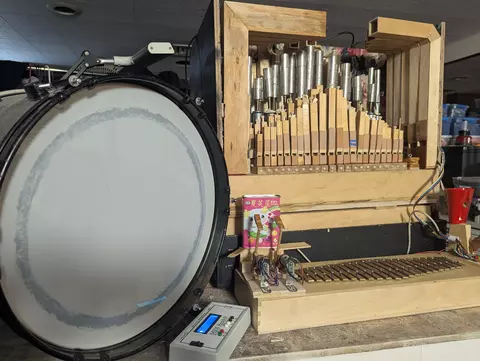
This is my street organ, based off of plans for the John Smith Topsy 3. It's not pretty, but it works!
I started work on this contraption November 2022. The construction has been an adventure in and of itself.
How did I make it?
After trying to replicate stuff I saw on YouTube, I finally decided to get some official plans so I could pattern my work after something functional. I stumbled across John Smith Organs and the discussion board belonging to The Busker Organ Music Site - buskerorgan.co.uk. I finally had a firm foundation. I quickly decided I wanted nothing to do with music punched onto paper, I went right for MIDI control. John Smith's Topsy3 organ is perfect for that. Of course, I wasted a whole lot of time and materials by "improving" the plans, so my advice is follow the plans, read the plans carefully, some of the design drawings are hidden among others and it's a bit of a puzzle. Watch the DVD that comes with the plans. It's worth it. Yes, I built all 100 pipes by hand, plus probably three times that many failures. Read the instructions!
How does it work?
It's a marvel of electropneumaticanichal artistry. It's primarily a pipe organ -- air pressure is generated by pumping bellows and regulated by a reservoir bellows. I have a powerful 3-phase DC motor that uses belts and pulleys for gear reduction so the bellows pump about 40-60 times a minute. I made the final drive pulley out of plywood, and it features a crank handle so it can be cranked manually. This regulated air pressure is fed into a box called the "wind chest" that has dozens of electrically-controlled valves. In my case these valves are electromagnets called "pallet magnets." Pallet magnets can be difficult for a home hobbyist to find, but I had great luck ordering directly from Peterson Electro-Musical Products Inc. . These valves open to allow air to pass through specific pipes to make musical sound.
How do you play notes?
Driver boards and register boards translate MIDI signals into on-off switches for the magnets to open and close the valves for pipes and for special actions like enable special ranks, activate the glockenspiel, stuff like that. The Topsy plans include diagrams to build the electronics if you're patient and ambitious. Otherwise you can get great boards from J-Omega Electronics and Klinger Organ.
How does it sound?
How do you make your own?
The plans and more information are here: John Smith Organs - Topsy 3 Plans -- support his legacy by buying your own copy of the plans.
- Log in to post comments
Thoughts and ideas
My thoughts on Topsy 3 vs Wurlitzer 105
I subscribe to an online discussion board about the Wurlitzer 105 band organ. There's lots of talented musicians, collectors, and technicians in that group and there's a wealth of information about these amazing instruments. Someone posted a question to the group asking for the pros and cons of MIDI vs paper rolls. Here's my response.
My perspective may be a little different from some others here. If I were fortunate enough to find a Wurlitzer 105 to restore, I'd probably keep it as close to its original design as practical. I follow this group because I hope to own one someday, and because there's a tremendous amount to learn from the builders and restorers here.
The bigger question is: what's your goal?
If your goal is to build a showpiece and learn traditional organ-building skills, a 105 is a fantastic project. If your goal is to start learning the basics, the John Smith busker is a proven design that teaches woodworking, tracking, bellows, and all the fundamentals.
I'd compare the busker to building a doghouse and a 105 to building an office building. They may use some of the same tools and materials, but they're in completely different leagues when it comes to size, complexity, cost, and time commitment.
To continue the metaphor, I see the Topsy as the cabin or small house between the doghouse and the office building. A busker teaches the fundamentals, but a Topsy introduces many of the challenges of a larger organ: multiple ranks, percussion, electrical systems, control systems, regulation, and tuning. At the same time, it's still realistic for one person to build and get playing.
I've been building a John Smith Topsy 3 for the past three and a half years. I had it making music after about eighteen months, despite spending plenty of time "improving" the plans and creating extra work for myself. It still needs adjustments and a proper case, but I already have an instrument I can enjoy.
Topsy was designed from the outset as a MIDI instrument rather than as a retrofit of a historic organ, so the plumbing and control system are fairly straightforward. You can see mine in action here: https://www.youtube.com/@rimbeaux
For me, the question isn't really rolls versus MIDI. It's how realistically I can build something that plays music. Some people view a 20-note busker as an introduction to organ building more than a musical destination, while a MIDI instrument can perform a much wider repertoire from day one. Neither approach is wrong; they simply serve different goals.
If I were starting from scratch today, I'd probably see the path as Busker → Topsy → 105, rather than Busker → 105. The 105 is absolutely worth aspiring to, but that's a very big jump for a first major build.