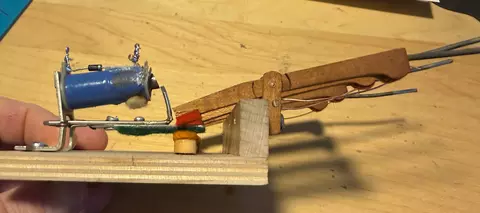
I wanted to share a close‑up of the hammer mechanism for my glockenspiel.
There are two levers involved in the action. The first lever is attached directly to the electromagnet frame. When the magnet is energized, it pulls this metal lever upward. That motion lifts the butt end of a second lever—a wooden seesaw lever—which has a felt pad at the butt end and the hammer head mounted on the opposite end. When the butt end goes up, the hammer end goes down and strikes the bar.
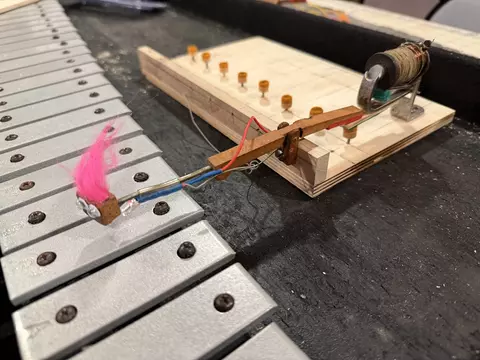
The bumpers supporting the butt end of the wooden levers are salvaged from an old piano. They’re mounted on screws in countersunk holes, which lets me fine‑tune the lever height simply by twisting the screws up or down.
The wooden lever assemblies are made from piano damper arms. I had to work out the geometry carefully and cut each lever to exactly the right length so the magnet would have enough mechanical advantage to drive the hammer effectively.
I removed the original damper arm springs and fabricated new ones. Each damper arm flange has two pins: a wooden pin that passes through the loop of the spring to hold it in place, and a separate metal pin that acts as the axle, allowing the arm to pivot on the flange. To install the new springs, I had to un‑pin the flanges, seat the springs correctly, and then re‑pin everything. I experimented with metal pin diameters to allow free motion without introducing side‑to‑side wobble.
I also experimented with different spring shapes and materials to get exactly the right action and response. And then I repeated this entire process for each of the 32 notes.
I decided to mount groups of the strikers onto plates to make it easier to build and maintain. Here you can see the magnet, capstan, rail, damper lever and flange, striker head, and the LED wiring.
- Printer-friendly version
- Log in to post comments