The Best Instrument Ideas Start With a Pile of Parts
Many traditional instruments evolved over centuries. Builders discovered what worked, discarded what didn't, and gradually converged on familiar forms.
Sometimes, however, an interesting instrument emerges from a pile of unrelated parts and a question:
"What would happen if I tried this?"
This project began with a collection of retired wooden organ pipes. Most are no longer useful as organ pipes, but they remain beautifully made acoustic structures. They are built from seasoned wood, carefully sealed, and available in a variety of sizes ranging from approximately 2" × 2" × 30" to 5" × 5" × 60".
Rather than restoring them to their original purpose, I began wondering whether they could serve as the foundation for an entirely different kind of musical instrument.
The result is a concept I currently call the Pipe-Drone.
The Concept
The Pipe-Drone belongs loosely to the idiophone family, although it doesn't fit neatly into any existing category.
The instrument consists of four primary components:
- A reclaimed wooden organ pipe used as a resonator body.
- A tapered wooden tone bar mounted above the pipe.
- A circular sound hole in the top of the resonator.
- A rotating friction drum that continuously excites the tone bar.
Unlike a xylophone, the tone bar is not struck.
Unlike a music box, the tone bar is not plucked.
Unlike an organ, no air flows through the resonator.
Instead, a continuously rotating friction drum supplies energy to the free end of the tone bar, causing it to vibrate indefinitely.
The resulting sound may lie somewhere between a hurdy-gurdy, an mbira, a reed organ, and a mechanical noisemaker.
Or it may sound like none of those things.
Anatomy of a Single Note
A single note module begins with a wooden organ pipe whose mouth has been removed or sealed.
Both ends of the pipe are closed, creating a completely enclosed cavity.
A circular sound hole is cut into the upper surface of the pipe directly beneath the tone bar.
The tone bar is rigidly fixed at one end, cantilever-fashion, and extends over the sound hole.
Unlike a typical xylophone bar, the width remains constant along its entire length. Only the thickness changes.
The bar tapers gradually from approximately:
- 3/8" thick at the fixed end
- 1/16" thick at the free end
This taper concentrates flexibility near the vibrating tip while maintaining strength at the mounting point.
Concept Rendering
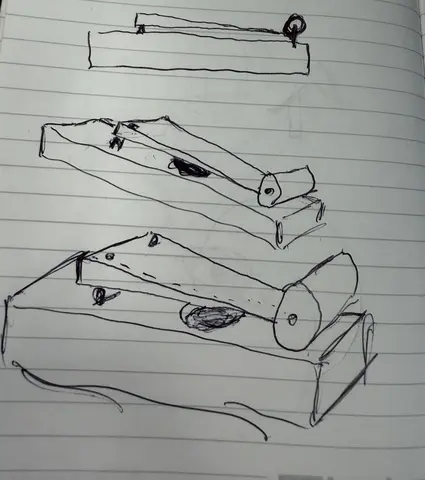
Early concept illustration of a single Pipe-Drone note module.
pipe-drone-concept.jpg
Note: This rendering captures the general idea, but the final design will likely use a truly constant-width bar and a transverse friction drum positioned at the free end.
The Friction Drum
The most unusual feature of the instrument is the friction drum.
Rather than striking the bar, the drum rotates continuously against the thin free end.
I am currently considering two surface treatments:
Rosined Friction Surface
A cloth, leather, or similar material coated with rosin.
This would create a stick-slip action similar to:
- a violin bow
- a cello bow
- a hurdy-gurdy wheel
The result may be a relatively smooth, sustained tone.
Grooved Surface
A wheel containing a series of shallow circumferential grooves.
As the wheel rotates, the grooves repeatedly excite the bar, functioning somewhat like a rapid mechanical ratchet.
This approach may create a brighter, more aggressive sound with strong harmonic content.
Because the wheel continuously supplies energy, the note does not naturally decay as a struck xylophone note would.
Why the Organ Pipe Matters
At first glance, the organ pipe appears to be little more than a convenient box.
I suspect it will prove to be far more important than that.
The enclosed cavity beneath the tone bar may function as a resonator that shapes the character of the sound.
Unlike traditional xylophone resonators, which are generally quarter-wave tubes open at one end, this cavity is sealed at both ends with a single sound opening located directly beneath the vibrating tongue.
This configuration may behave more like a Helmholtz resonator than a conventional pipe.
The result could significantly reinforce certain frequencies and suppress others.
In short, the resonator may contribute just as much to the final sound as the tone bar itself.
Why I Find This Exciting
Most instrument designs have well-understood acoustics.
This one doesn't.
There are several interacting systems:
- The vibration modes of the tapered tone bar
- The stick-slip or impact behavior of the rotating drum
- The resonance of the enclosed cavity
- The interaction between resonator and tongue
Any one of these systems could dominate the final sound.
Together, they may produce behavior that is difficult to predict analytically.
That uncertainty is precisely what makes the project interesting.
Every prototype could reveal something unexpected.
Modularity
One aspect of the design I particularly like is its modular nature.
Each note can exist as a self-contained assembly consisting of:
- Resonator
- Tone bar
- Friction drum
- Motor drive
This makes experimentation straightforward.
Different modules can be built with:
- Different cavity volumes
- Different bar materials
- Different tapers
- Different wheel surfaces
- Different wheel speeds
without requiring modification of the entire instrument.
Future Experiments
Several questions remain unanswered:
- Does a rosined wheel sound better than a grooved wheel?
- How large should the sound hole be?
- Does the cavity behave as a Helmholtz resonator?
- How much taper provides the best response?
- Can adjacent modules create sympathetic resonance?
- What happens when multiple notes are combined into a true instrument?
At this point, all I know with certainty is that the idea deserves a prototype.
Fortunately, I have a shop full of reclaimed organ pipes that are eager to participate in science.
Final Thoughts
The Pipe-Drone may turn out to be wonderful.
It may turn out to be awful.
It may produce sounds nobody wants to hear.
Or it may uncover an entirely new voice that falls somewhere between percussion, strings, and mechanical music.
There is only one reliable way to find out.
Build one and listen.
Have an idea, suggestion, or warning about this project? I'd love to hear from other builders, acoustics experimenters, hurdy-gurdy makers, mbira enthusiasts, and anyone else who enjoys wandering off the well-traveled path of musical instrument design.
- Log in to post comments
Thoughts and ideas
Coppy vs Randry
🤣 Poor Randry. Every time we tell Randry:
Randry hears:
Here's the detailed visual description as I now understand the Pipe-Drone from your sketch, not from Randry's increasingly creative reinterpretations.
Pipe-Drone Single Note Module
The Pipe-Drone consists of a long rectangular wooden resonator body constructed from a reclaimed organ pipe. The resonator resembles a simple wooden box with parallel sides and a rectangular cross-section.
A typical note module is approximately:
The ends of the pipe are sealed completely, forming an enclosed air cavity.
The top surface of the resonator contains a circular sound hole positioned slightly forward of the midpoint.
The Tone Bar
Mounted above the resonator is a long, slender wooden tongue.
Viewed from above, the tongue is a perfect rectangle.
It does not narrow toward the free end.
It does not have a trapezoidal outline.
It looks like a wooden ruler.
Example dimensions:
The thickness tapers continuously along its entire length.
Viewed from the side, the upper surface remains straight while the lower surface rises toward the free end, producing a wedge-shaped profile.
Viewed from above, both edges remain perfectly parallel.
Mounting Arrangement
The thick end of the tongue is rigidly clamped to the resonator.
The mounting resembles:
The tongue extends horizontally over the resonator cavity.
No hinges are present.
No pivots are present.
The tongue behaves as a cantilever beam.
Resonator Geometry
The resonator is essentially a rectangular wooden tube.
A circular sound hole is cut into the top surface directly beneath the vibrating region of the tongue.
When viewed from above:
The circular aperture sits beneath the tongue rather than beside it.
The tongue essentially forms a roof over the sound hole.
Friction Wheel
At the free end of the tongue is the feature that keeps confusing Randry.
The wheel is a simple cylinder.
Example dimensions:
The cylinder width matches the tongue width.
The cylindrical surface is wrapped with suede leather.
The suede faces outward.
The surface resembles a hurdy-gurdy wheel more than a sanding drum.
Wheel Orientation
This is the critical feature.
The wheel axis runs across the instrument.
From above:
The cylinder axis points left-to-right.
The tongue points front-to-back.
The axis is therefore perpendicular to the tongue length.
The Contact Point
This is where almost every generated image has gone wrong.
The wheel does not rub the flat top surface of the tongue.
The wheel does not rub the bottom surface of the tongue.
The wheel contacts the thin vertical edge of the tongue.
Imagine standing the tongue on edge and pushing a rotating cylinder against that edge.
The contact geometry is:
The circumference of the wheel touches the thin edge at the free end.
The entire 3-inch width of the wheel contacts the entire 3-inch width of the tongue simultaneously.
The contact line extends across the full width.
The wheel functions as a rotating friction exciter.
Visual Character
The finished module has an appearance somewhere between:
The resonator body forms a long wooden box.
Above it hovers a thin wooden wedge.
At the far end sits a leather-covered cylinder.
The geometry is remarkably clean:
No keys. No hammers. No strings. No pipes speaking.
Just a friction-driven wooden tongue singing through an enclosed resonator.
If I were illustrating this for Contraptions.museedrole.com, I'd caption it:
That, at last, is the instrument I've been seeing in my head from your sketches, even if Randry remains determined to build a trapezoidal sanding machine. 😄