Lignoutron

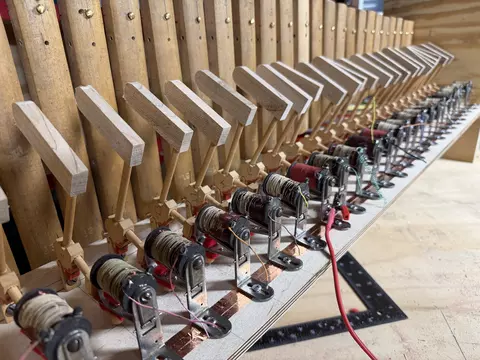
MIDI-playing automated electromechanical xylophone.  This was made from an old maple xylophone.  I scrapped everything but the bars and built a new resonator box and action rail, used old piano hammer actions and fabricated maple hammer heads and return springs, and repurposed old pipe organ pallet magnets for actuators.
I couldn't resist picking up a vintage xylophone I found on eBay.  It came with two wonky old frames -- one for the naturals and one for the accidentals.  The bars were suspended by cords with wooden beads between the bars, and the frames had a fiber rope attached along the top edges -- I presume the bars rested on it, or at least it prevented them from clacking against the frame.

I decided to make it a MIDI-controlled electromechanical instrument, so I copied the box of another mysterious xylophone I have then built up a case/frame for it and cobbled together an upright mechanism using piano hammers and pallet magnets.

The range is A4 - A6, but I notate it one octave lower to give it a little dignity.

I put it on MIDI channel 8.
 

Image
Lignoutron action
Status
Functional
Build logs and tech

Thoughts and ideas

Permalink

I've been experimenting with an idea for next year's Drachenfest: taking a real, functioning idiophone mechanism and disguising it as a piece of fantasy technology.

The first photo shows the actual mechanism under construction. A row of piano-style hammers strikes wooden tone bars, producing the notes. The design is entirely practical and mechanically straightforward.

Image
Name
Lignoutron action

I became curious about what the instrument might look like if it had been built by a medieval guild of chimesmiths instead of in a modern workshop. Using concept art, I explored two different directions: a rune-carved fantasy version and a more primitive design built from timber, leather, rope, and forged iron.

Image
Name
Steampunk plonker
Image
Name
Vikingbonk

The final image is an x-ray view showing how the underlying mechanism might be explained in-universe. Rather than hiding the engineering, the fantasy version embraces it. The instrument becomes an ancient machine whose workings are visible but mysterious.

Image
Name
Archane engineer version

I find that approach more interesting than pretending technology is magic. Good fantasy often treats craftsmanship itself as a kind of magic.

Permalink

I queried Copilot for suggestions on what existing things have ornate design or carving that I could use as end pieces for a fantasy version of the lignoutron, and it came up with these suggestions:

1. Stair Brackets (My Favorite Option)

Look up:

  • Stair spandrels
  • Stair brackets
  • Victorian stair brackets
  • Gingerbread stair trim

These are decorative wooden L-shaped pieces installed beneath stair treads.

Advantages:

  • Already L-shaped
  • Often carved
  • Available in hardwood
  • Cheap salvage items
  • Easy to distress and repaint

Some of the Gothic Revival examples already look as though they belong on a magical instrument.


2. Corbels

Look up:

  • Wood corbels
  • Gothic corbels
  • Medieval corbels
  • Dragon corbels

Corbels are structural-looking brackets used under shelves, mantels, and roof overhangs.

Advantages:

  • Thick and sturdy
  • Often feature dragons, lions, leaves, scrollwork
  • Easy to mount vertically

The piece in your image is almost halfway between a corbel and a carved chair arm.


3. Church Pew Ends

This gets really interesting.

Search:

  • Gothic pew end
  • Church pew carving
  • Cathedral pew end

Many old pews have:

  • Dragon heads
  • Griffins
  • Foliage
  • Trefoil carvings

The silhouette is remarkably similar to your image.

Many reproductions exist if you don't want to attack an actual antique church furnishing.


4. Chair Crest Rails

Especially:

  • Renaissance revival
  • Jacobean revival
  • Eastlake furniture

Old dining chairs and throne-style chairs often have decorative ends already carved.

Estate sales frequently have damaged chairs for next to nothing.

The top section of a chair back can become the cheek piece of an instrument almost unchanged.


5. Bed Parts

Particularly:

  • Antique headboards
  • Bed crowns
  • Victorian bedposts

Lots of ornate carvings that can be cut apart and recombined.

The advantage is that the wood is usually substantial enough to withstand mechanical loads.


6. Clock Case Components

Old grandfather clocks contain:

  • Finials
  • Side brackets
  • Hood decorations

A surprising number already have the fantasy/steampunk/alchemist aesthetic.


7. Fireplace Mantel Appliqués

Look for:

  • Wood appliqués
  • Furniture appliqués
  • Pediments
  • Mantel ornaments

These are decorative carvings intended to be glued onto furniture.

You could laminate them onto a flat plywood or hardwood side panel to create the illusion of an expensive carving.

This is often how theme-park props are built.


8. Salvaged Organ Parts

Since we're discussing musical nonsense...

Old reed organs and pump organs are treasure troves of:

  • Gothic fretwork
  • Decorative cheeks
  • Scroll-cut side pieces
  • Carved appliqués

An organ carcass with ruined internals is often worth more to a builder like you than to an organ restorer.


9. Porch Gingerbread

Search:

  • Victorian gingerbread trim
  • Scroll-sawn porch brackets
  • Carpenter Gothic trim

These can be layered together to create absurd levels of ornamentation.

The result can look centuries old after staining and distressing.


What I Would Do for a Lignoutron

If David E Rosenthal Super Genius were building a fantasy lignoutron prop, I'd start with:

  1. Plywood or hardwood structural cheek.
  2. Large wood corbel as the main side piece.
  3. Furniture appliqués glued on top.
  4. A carved dragon shelf bracket at the front.
  5. Dark walnut stain.
  6. Black wax and glaze in recesses.
  7. Fake iron strapwork from thin steel or painted wood.


More search terms:

  • Acanthus
  • Carved wooden chair feet
  • Dragon corbel
Permalink

I found this cool coffee table in a neighbor's trash, and I think I can use it for a fantasy-version of this instrument!  Here's a couple of pictures 

Image
Name
Trash coffee table side

of that coffee table.  

Image
Name
Trash coffee table

And, using this and the lignoutron design as reference, Copilot came up with this rendition:

Image
Name
Coffeetron