Name
Crank-Operated Bass Reed Organ Concept
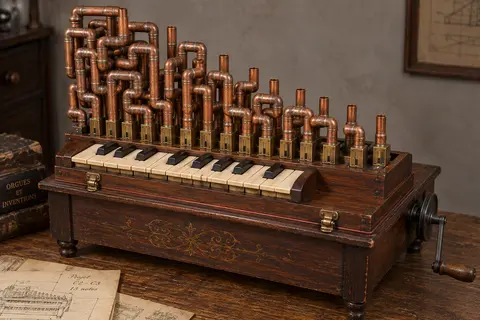
This project began with the surviving lower half of an antique orguinette. The original upper mechanism is missing, but the base still contains the hand-operated suction bellows, vacuum reservoir, crank mechanism, and a long tapered air-intake slot where the original playing mechanism once connected.
Rather than trying to reconstruct the missing paper-roll mechanism, I want to use the surviving base as the power source for an entirely new instrument: a small, hand-cranked reed organ played with one hand.
The proposed upper section would be removable, taking advantage of the way the original orguinette appears to have been designed with a detachable upper mechanism. The new top would contain a compact one-octave chromatic keyboard, probably C2 through C3, along with thirteen salvaged reed-organ reeds. The reeds would sit in a row over a common vacuum chamber connected to the orguinette's existing air-intake slot.
The crank would remain on the right side of the instrument, allowing the player to operate it continuously with the right hand while playing the keyboard with the left. The existing bellows would create suction, and the reservoir would even out the airflow just as it did in the original instrument.
The deliberately ridiculous part is the resonators.
Each reed would have its own resonator made from ordinary copper plumbing pipe. The low reeds require long acoustic paths, but instead of using tall conventional organ-style resonators, the copper pipes would fold repeatedly back and forth using soldered elbows. The idea borrows something of the compact, folded-bore philosophy of a rackett, except realized with the contents of a plumber's scrap bin.
The C2 resonator would be particularly absurd, winding up, across, down, back, and up again through numerous elbows. Each successive note would require less tubing, producing a gradually descending forest of increasingly compact copper plumbing across the instrument.
The resonators are experimental rather than essential. The free reeds can produce their own pitches without them, so the idea is to see how different lengths and configurations of tubing affect volume, tone, and character. A prototype with a single low reed should reveal whether the folded resonators contribute enough acoustically to justify their spectacular mechanical foolishness.
Another possibility is to make multiple interchangeable tops. I have four complete ranks of 63 reed-organ reeds, with different timbres. A standardized pneumatic and mechanical interface could allow one keyboard/reed assembly to be lifted off and another installed, perhaps with different ranges, different reed ranks, or different resonator arrangements.
The goal isn't to create a fake Victorian instrument or a steampunk prop. I want the finished object to look peculiar because it actually works that way. The original orguinette supplies the mechanical power and vacuum system, the salvaged organ reeds supply the voices, and an unreasonable quantity of soldered copper plumbing supplies the visual absurdity.
In short, it's what might have happened if an orguinette, a reed organ, a rackett, and a plumbing project had somehow produced offspring.
Status: concept.
Working principle: hand crank → suction bellows → vacuum reservoir → removable reed chest → keyed free reeds → extravagantly folded copper resonators.