Lignoutron build log
Lignoutron build log
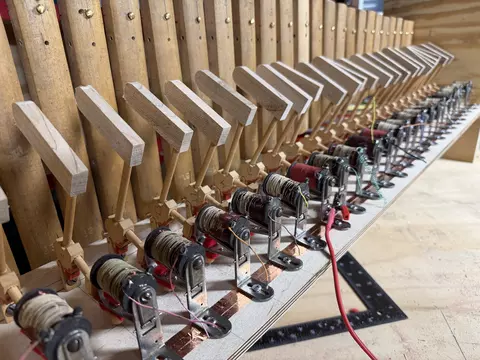
Who doesn't want a self-playing xylophone? Here's some of the work I did to make this thing a reality.
This image shows the hammers and actuators lined up and all ready to strike those bars!
Original xylophone
Original xylophone
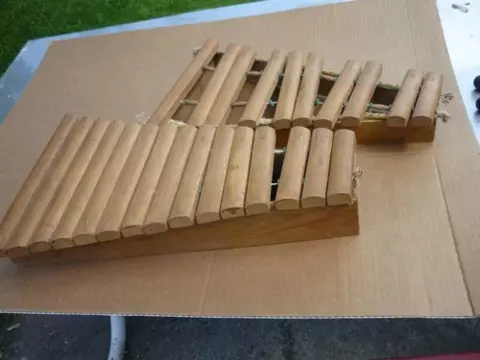
I got this very cheap on eBay. It's clearly not very pretty, but all the bars are there. I salvaged the maple bars and built a whole new instrument for them.
Xylophone in suspense!
Xylophone in suspense!
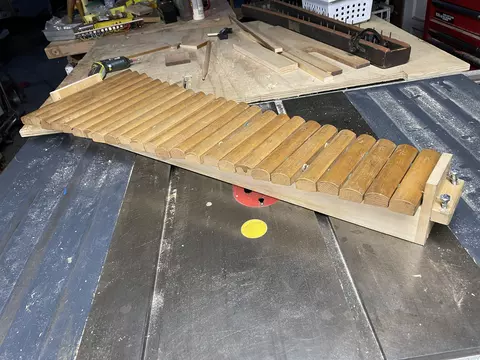
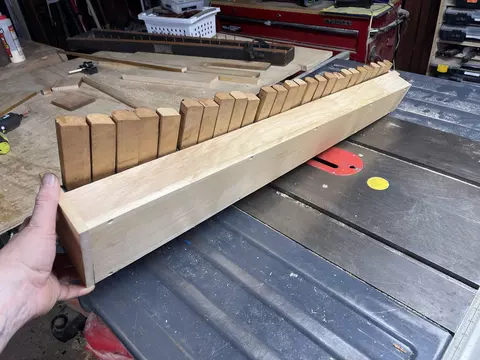
One of the early iterations. I tried suspending the bars above the resonator box with wire, as an "improvement" to the string suspension it had originally. I learned a whole bunch from this experiment, including the idea that I painted myself into a corner laying the bars out with so little room between them. I was building the frame from scratch so there was no reason to try to squish it all together.
Initial build-up
Initial build-up
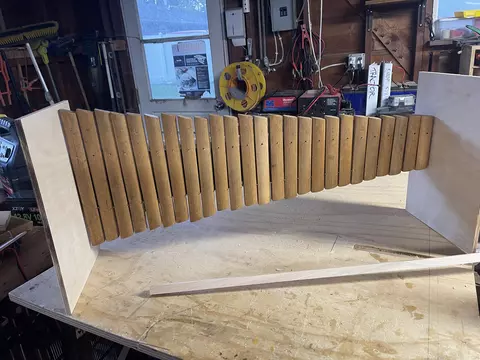
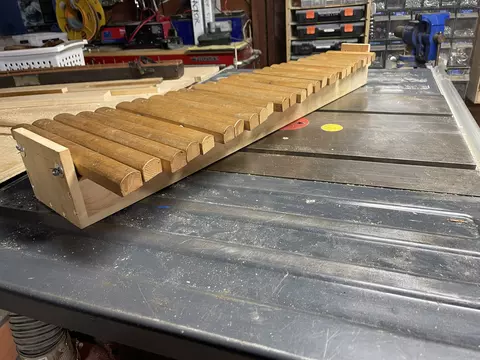
Here's an initial assembly of the instrument with its resonator box suspended between plywood boards.
Experimental double-hammer version
Experimental double-hammer version
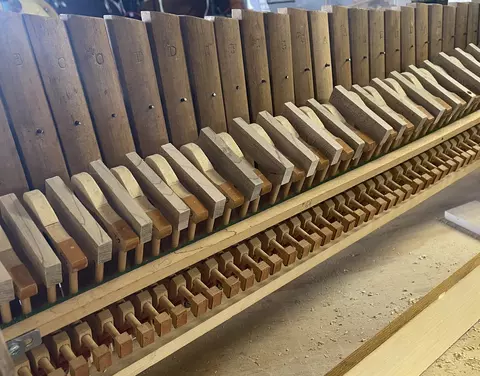
I originally thought it would be fun to give this instrument some amount of registration, so I built it with alternating hard and soft hammers, with the idea of sliding the rail side to side to select which hammer was used.

The idea was the hammers were skinny enough so sliding the rail back and forth would allow the actuator to lift only one of the hammers. I gave up on this idea because I just couldn't imagine having enough force to move that heavy rail fully-populated.
Resonator box
Resonator box
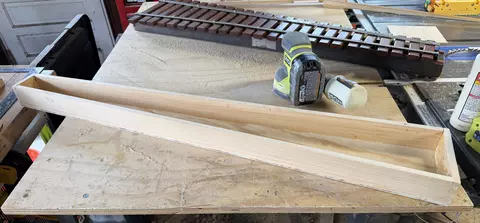
This is the second iteration of the resonator box. Initially I started with the concept of my Deagan Orchestrion Xylophone's resonator box and laid-out the bars side by side with a uniform gap between them and used nails for mounting pins on the top and nails between each bar to space them on the bottom. I essentially painted myself into a corner by making such a tight footprint, and the bars really didn't have much freedom to resonate. Eventually I took the whole thing apart and started over. I used the Deagan box more as a template and built the resonator box much more carefully. I glued piano tuners' temperament cloth to the edges, mounted the bars just at the top and let them hang loose at the bottom. I gave myself quite a bit more space between the bars and that made the whole thing easier to assemble and regulate.
I built this with box joints for a nicer look and to make up for the angles; I was just too lazy to measure and miter everything so precisely. I salvaged old organ pipes for the lumber.
Counter bored
Counter bored
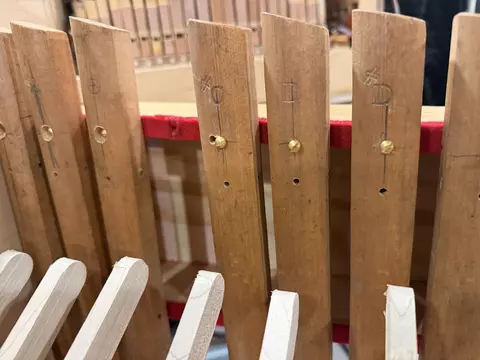
After several different approaches, I think counter-boring the screw holes gives the best results. Here you can see the counter-bored bars on the left and the normal screw holes on the right.
And here's the device I just got to ensure a perfectly straight hole with consistent depth:
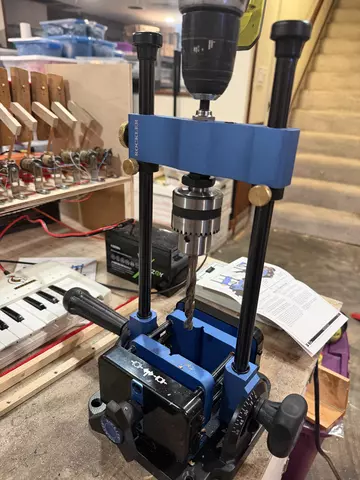
This setup is well worth the money, especially with the 25% Fathers' Day discount (thanks Dad!!).