Big organ build
Big organ build
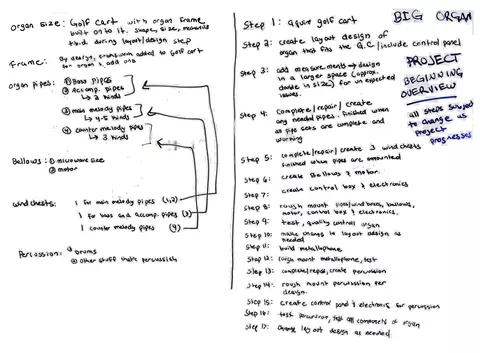
Amanda created the project plan for this organ design.
This book documents the complete design, construction, and testing process for the BIG ORGAN project: a multi‑rank pipe and percussion organ mounted on a golf cart.
It includes subsystem descriptions, build steps, and iterative design notes.
All steps are subject to change as the project progresses.
Build steps
Build steps
This chapter documents the chronological build process for the BIG ORGAN.
Each step can be updated as the design evolves.
Adjust the layout design
Adjust the layout design
Modify the layout based on test results and practical constraints.
Update drawings and measurements.
Build control box and electronics
Build control box and electronics
Create the main control box, wiring, and electronic actuation systems.
Include diagrams, pinouts, and safety notes.
Build the controls for percussion
Build the controls for percussion
Create the control interface and electronics for percussion actuation.
Include wiring diagrams and control mappings.
Build the motor and bellows assembly
Build the motor and bellows assembly
Construct the bellows and motor system that supplies wind to the organ.
Document pressure tests, flow rates, and noise levels
Create an initial layout design
Create an initial layout design
Design the organ layout to fit the chassis, including control panel placement.
Capture sketches, constraints, and initial ideas.
Expand on the design with measurements
Expand on the design with measurements
Add precise measurements and expand the design in a larger space (about double size) to allow for unexpected needs.
Record clear dimensions and reserved clearances.
Final adjustments
Final adjustments
Make final design changes based on full‑system testing.
Capture the “as‑built” layout and any lessons learned.
Mount and test ideophones
Mount and test ideophones
Install the metallophone in rough‑fit configuration and test actuation and balance with pipes.
Mount and test the percussion
Mount and test the percussion
Install percussion components for initial testing.
Check clearances, vibration, and access.
Obtain a mobile chassis
Obtain a mobile chassis
Procure a suitable the mobile chassis, such as a golf cart, tug, trailer, or whatever.
Document model, load capacity, and any initial repairs.
Obtain ideophones
Obtain ideophones
Source metallophones, glockenspiels, xylophones, etc. Construct the metallophone assembly, including bars, frame, and actuators.
Document tuning and mounting.
Obtain percussion instruments
Obtain percussion instruments
Create or restore all percussion instruments planned for the organ.
Note materials, mounting, and actuation.
Obtain pipe sets
Obtain pipe sets
Create, repair, or restore all pipe sets.
Completion criteria: all pipes are functional, reasonably in tune, and mechanically sound.
Obtain wind chests
Obtain wind chests
Construct or repair all three wind chests.
Completion criteria: airtight, valves working, ready to accept pipes.
Rough mount all components
Rough mount all components
Rough‑fit pipes, wind chests, bellows, motor, control box, and electronics on the golf cart.
Focus on access, stability, and cable/hose routing.
Test and troubleshoot
Test and troubleshoot
Perform airflow tests, valve checks, tuning passes, and mechanical inspections.
Log issues and proposed fixes
Test percussion and full system
Test percussion and full system
Test percussion alone, then test all organ components together as a unified system.
Log timing, balance, and reliability issues.
Organ structure and components
Organ structure and components
This chapter describes the physical structure of the BIG ORGAN: its size, frame, pipe families, bellows, wind chests, and percussion.
It serves as a reference for all mechanical and acoustic subsystems.
Bellows and motor
Bellows and motor
Design notes for the microwave‑sized bellows and motor assembly.
Includes airflow targets, pressure goals, and mounting considerations
Frame construction
Frame construction
Describes the framework added to the golf cart to support pipes, wind chests, bellows, electronics, and percussion.
Includes mounting points, materials, and structural bracing.
Organ size and layout
Organ size and layout
Defines the overall footprint of the organ as mounted on a golf cart.
Includes height, width, depth, and constraints such as visibility, weight distribution, and transport clearances.
Other voices
Other voices
Let's talk about incorporating other instruments to compliment the melody and counter melody ranks, such as the glockenspiel.
Percussion
Percussion
Overview of percussion elements integrated into the organ, including drums and additional percussive instruments.
Focuses on mounting, actuation, and balance with the pipe sound.
Additional percussion elements
Additional percussion elements
Other percussive instruments (e.g., bells, blocks, shakers).
Notes on placement, triggering, and integration with the main organ sound.
Drums
Drums
Drum selection, mounting methods, and actuation mechanisms.
Includes considerations for volume control and mechanical noise.
Pipe families
Pipe families
Overview of all pipe groups used in the organ: bass, accompaniment, main melody, and counter‑melody.
Each family has its own scaling, voicing, and wind requirements.
Accompaniment pipes, two ranks
Accompaniment pipes, two ranks
Details for both accompaniment ranks, including tonal role, scaling, and wind needs.
Notes on blending with main melody and bass.
Bass pipes
Bass pipes
Specifications and layout for the bass pipe set.
Includes scale, materials, and placement for optimal low‑frequency projection.
Counter melody pipes, three kinds
Counter melody pipes, three kinds
Information on the counter‑melody ranks and how they interact with the main melody.
Focus on contrast, register, and articulation.
Melody pipes, four to five different kinds
Melody pipes, four to five different kinds
Description of the primary melody ranks and their intended character.
Includes considerations for brightness, attack, and tuning stability.
Wind chests
Wind chests
Overview of the three wind chests and their pipe assignments: main melody, bass & accompaniment, and counter‑melody.
Describes general valve logic and air distribution.
Bass and accompaniment wind chest
Bass and accompaniment wind chest
Let's consider a combined wind chest design serving both bass and accompaniment ranks.
Notes on balancing pressure and avoiding crosstalk.
Counter melody wind chest
Counter melody wind chest
Wind chest design dedicated to counter‑melody ranks.
Focus on responsiveness and isolation from other chests.
Main melody wind chest
Main melody wind chest
Layout and valve logic for the main melody pipes.
Includes channel routing, pallet design, and connection to the bellows.